How to Build a Temporary Wood-fired Brick Pizza Oven with Cheap, Easy to Find Materials
Written by mike on October 5th, 2009(Quick reminder: Simply RT this post or post a comment below to get in on the monthly giveaway. Other ways to enter too!)
This is a great, low-cost project for someone who wants to test out the ins-and-outs of brick oven cooking. Super fast and easy to build, and with minor modifications, it can be assembled semi-permanently and get you through a season of baking delicious breads and pizzas.
I attended a fantastic pizza making event at Machine Project (instructor: Michael O’Malley) that included the construction and firing of a DIY temporary brick pizza oven – the ultimate in pizza cooking. Hugely educational and inspiring, even for a committed pizza fanatic such as myself. The oven, built, fired up, and torn down over the course of an afternoon, worked amazingly well – I cooked the best pizza I’ve ever made, by far.
Here’s a basic rundown on how the pizza oven was assembled. Firebricks and fireclay are available at kiln and pottery supply stores. Use these over standard red bricks as the red bricks tend to pop or explode when reaching extreme temperatures. The metal table might be the most challenging/expensive component used – watch Craigslist for used welding tables. Pavers are found cheaply at Home Depot, Lowes, or gardening/hardware stores.
(Note: bricks are heavy, and brick ovens generate a lot of heat. Please use proper precautions to ensure that you don’t burn or crush yourself while making or using your oven.)
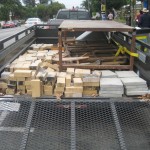
- Firebricks, pavers, and a heavy metal table. All the materials needed for our oven.
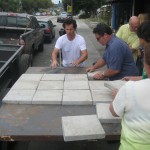
- Make sure the table is strong enough to hold the weight of the bricks and pavers, and can withstand the heat. Lay out the pavers first to create an insulating buffer.
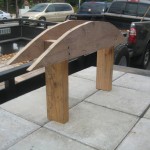
- This is the jig that will be used to form the archway.
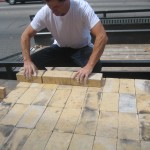
- On top of the pavers, lay down a tight-fitting pad of fire bricks. Keep them as even as possible–this will be the floor of the oven.
- Build up the back wall, using half-sized bricks along the sides to keep everything fairly even.
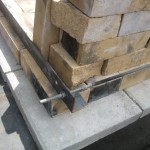
- With the back wall set, place a length of angle iron along what will become the side walls. The angle iron pieces are pre-drilled for threaded rod to extend across and keep the side walls fitting snug.
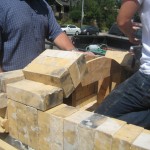
- The side walls shouldn’t be too tall – you want to keep the internal heat contained in a low area. A standing brick is the right size. Continue these all the way forward on both sides, keeping the bricks as tight as possible.
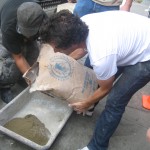
- With the side and back walls finished, it’s now possible to start sealing. A mix of fire clay and sand will keep in the smoke and some heat, but isn’t weather proof – this allows you to clean and disassemble the oven easily.
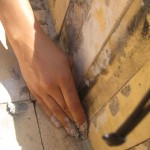
- Apply the mix to the corners and all seams. Use a liberal amount of it to make sure no gaps form when it dries.
- The archway is formed on top of the jig, starting from the back. Put the bricks on from both outside edges, moving inwards.
- A small shard of broken brick helps maintain the spaces that occur by the curvature of the arch.
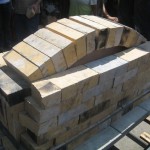
- Before removing the jig, place another layer of bricks onto the sidewalls and lock them in place with angle iron, as done on bottom. Once done, the jig can be shimmied out to let the brick arch settle into place.
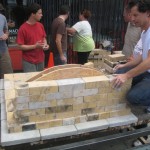
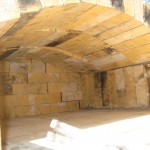
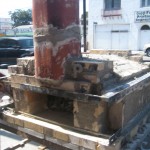
- Three layers of bricks gives a fairly sizeable pizza area. You can see how they stack tightly.
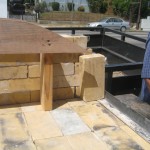
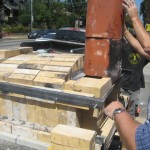
- Another piece of angle iron bridges the bricks on the side of the opening (large enough for a peel but not too large). Bricks on top leave a space for the chimney to vent from. Keep the chimney in front, to help pull the heat forward from the burning wood at the back of the oven.
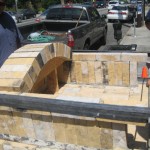
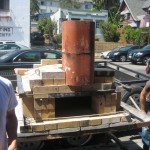
- Here is the front of the pizza with the bricked-in chimney and walls.
- A healthy slathering of the sand/fireclay mix on the roof and chimney areas help seal everything from escaping heat and smoke.
- The chimney and walls are now sealed.
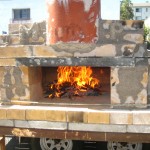
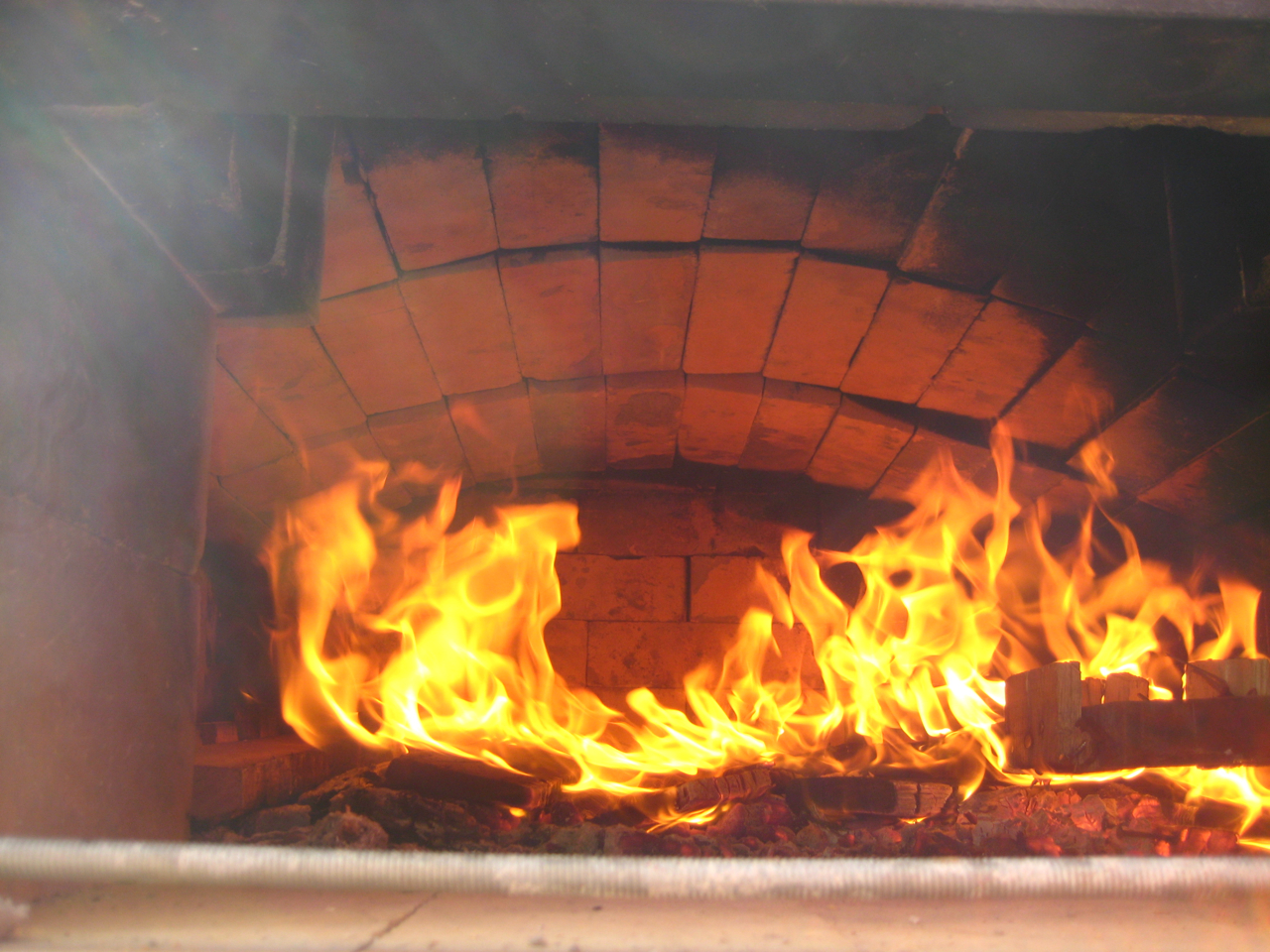
- Firing up! Start the fire small to let the heat build gradually, without blowing a ton of smoke out the top.
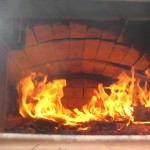
- As the fire continues, soot collects on the interior of the dome. After the heat raises, the soot cooks off.
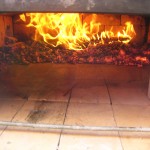
- This design doesn’t have the same heat retention as a multi-thousand dollar commercial unit, so reaching the idea temperature can take 60-90 minutes or more. Once it’s hot enough, sweep the embers to the back and use a wet toweled stick to mop the bricks.
- This is my pizza, about 2 minutes into cooking. The crust had a crispy exterior and a soft chewey interior, with the perfect char. Tastiest pizza I’ve ever made.
Finally, here’s a video of the oven we built in action. Enjoy!
Don’t forget, you’ll need to get a pizza peel and a decent slicer. I like to use a wood peel for preparation and inserting (dough doesn’t stick as much to wood), and a metal peel to take the pizza out. This design doesn’t need a very long handle, but larger ovens will warrant it.
The Mario Batali pizza slicer is the best slicer I’ve found. Cleaver-like satisfying heft, oversized sharp, smooth wheel and comfortable handle. It cuts through anything without dragging the pizza across the plate. I actually bring this with me to friends’ pizza parties now–it’s spoiled me.
If you have any questions, comments discoveries or discoveries, please post them in the comments.
Monthly Giveaway! Every month I’m giving away a nice prize for helping support DO IT and spreading the DIY love. Here’s how to get in on the action.
Related posts:
- A Rundown of The Top DO IT Posts For Your Weekend DIY Inspiration
- (Quick reminder: Simply RT this post or post a comment below to get in on...
- DIY Builder Holiday Buying Guide – Gift Tips
- A few Holiday suggestions that I’ve been enjoying this year, for the science geek/builder/pizza fanatic...
- Make Your Own Wooden Pizza Peel (Paddle)
- A pizza peel (that’s the proper name) is a must-have tool for any pizza...
- What My NY Pizzeria Safari Taught Me About Making Pizza
- (Quick reminder: Simply RT this post or post a comment below to get in...


6
AM
Man, that looks like a tasty pizza at the end. Would I like a piece? Don’t mind if I do.
8
AM
Wow, that looks superb!
If I wanted to make this oven a bit more permenant, are there any changes that would need to be made?
8
PM
MarkP-
To make it more permanent, you’ve got a couple things to consider.
1. The “mortar” used on the bricks (to control smoke rather than cement the bricks in place) doesn’t harden when dry, meaning that any rain or errant lawn watering threatens to wash the sealant away.
2. The bricks, being one layer deep, get pretty hot during cooking. A lot of the professional ovens use an exterior housing over the interior brickwork to protect from the intense heat.
Done right, one easy solution can fix both these problems. I’ll be putting one of these together in my current house in the next couple weeks, and plan on adding a simple “doghouse” type structure over it to protect from the elements. Some research still needs to be done on the heat that the outside of the bricks reach, but it seems that a lining of sheetrock should suffice to keep things from bursting aflame. And, left simple, I’ll be able to disassemble and move to my next place (which may be sooner than later).
There reaches a point when you put too much work into an oven of this design and you would have been better set putting the time and effort into a proper oven design. Plenty of resources on how to do them more permanently are around – check http://fornobravo.com as a starter (they have an amazingly active message board).
Also, thanks for reading and the enthusiasm!
-Mike
9
AM
check out this insulating blanket you can use.
http://www.fornobravo.com/store/FB-Blanket-50-p-16286.html
15
AM
Really enjoyed reading your blog post. I will have to bookmark your site for later.
17
PM
What an awesome idea. Bringing wood oven cooking to the streets!! Thanks for the post.
Here is a good resource if you are looking to build an oven.
http://www.traditionaloven.com/index.html
18
PM
This is excellent! I just posted about this today on my blog as well.
21
AM
Mike
Nice work! I live in S. Cal too and wonder where you bought your firebricks?
22
PM
Al,
Check this place. You can also talk to them about kiln shelves instead of firebricks. Just make sure you get enough thermal mass to absorb and radiate the heat for a while.
http://lagunaclay.com/
-Mike
26
AM
Hello!
I love the concept and I am planning to build one as well (not temporary though.
Would you mind telling me the size of the bricks you are using to have an idea of how large the oven actually is?
It would be nice to have the dimensions of the bricks to compare with what’s available over here (I am in Spain
Do you know any website where I can find plans for pizza ovens? I have looked on the links above with no luck… (no specific dimensions and plans posted).
Thanks!!!
Andrea
14
PM
hey mike,
thanks for the terrific step by step pics. i just have one question: what ballpark of a budget do you think I should have if i want to construct something like this? i mean just for materials (not including labor).
Thanks
Charles
14
PM
Charles,
It really depends on how resourceful you are, and how permanent you want to make this.
The two biggest costs will be the firebricks and the table to put it on.
Firebricks are around $2 or $3 each. On the oven we built, the floor alone had 50 of these bricks. You can cut the cost significantly by using red chimney bricks for the sides and top (arch). Red bricks are much cheaper, about 75¢ each – or just go on Craigslist and find someone giving them away free. Not a great long-term solution, but it will work. Be careful to keep them dry.
The metal table looks like it can run up to $400 used on Craigslist too. Metal’s not cheap! Avoid that by making raised platform using cinderblocks with a couple sheets of 3/4″ plywood screwed together for the top. If you have a wood top, I’d recommend a double layer of pavers to insulate it from the heat. Again, might not be the best permanent setup, but can be easily disassembled and stashed in the shed when not in use.
I’ve even seen a writeup of someone using a scrapped, old fireplace for the base of their oven.
If you go the salvage/cheap route, I’d estimate about $200-$300 for materials. The priciest part being the firebricks for the floor. And in fact, this is the way I plan on building one over the holidays.
14
AM
Good afternoon, Mike.
May I trouble you for an estimate of the total weight of the completed oven?
Thanks!