How Those Crazy Punkin Chunkin Machines Work – Cannons, Trebuchets, Centrifugals and Onagers – Behind the Chunk!
Part of hosting the Science Channel coverage of the 2009 Punkin Chunkin World Championships with Zach Selwyn means I get to do a few web videos to explain the ins-and-outs of how the amazing machines at the event work. These web spots are called “Behind the Chunk.” Here’s what I filmed, with some further information.
Also, if you’re looking to build your own trebuchet, check out my roundup of online trebuchet plans and blueprints.
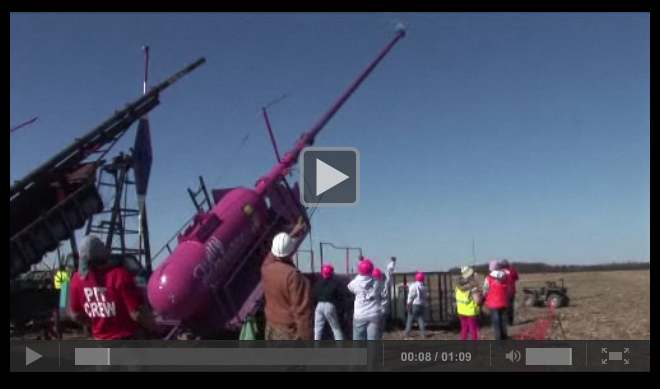
Air Cannons: Consist of three components: Chamber, valve and barrel.
With the valve closed, the chamber (a large tank) is pressurized with a compressor that is a lot bigger than the pancake compressor you get in a kit from Home Depot. On the other side of the valve, a pumpkin is placed at the bottom of the barrel, which can reach up to 100′ in length. A good pumpkin will have a spherical shape that sits perfectly inside the barrel to allow the least amount of air to flow past it. The valve is opened as quickly as possible (the winning machines’ valves are hydraulically actuated), and the pressurized air rushes out of the chamber and down the barrel. The speed and force of this air is sufficient to shove the pumpkin at an incredible rate of speed. On the furthest throws, the pumpkins approach supersonic speeds as they exit the barrel – very impressive.
Example: Chunkonology
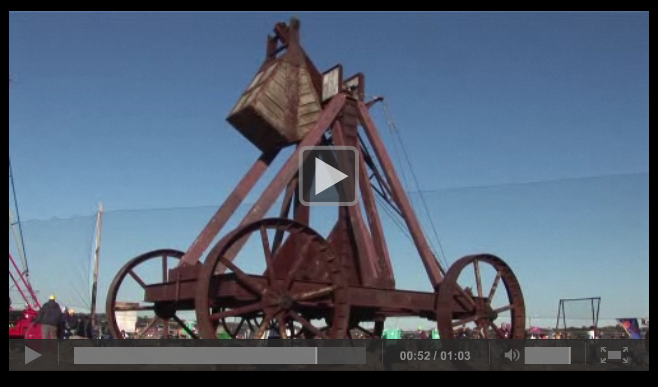
Trebuchets: Consist of a counterweight, a throwing arm, and a sling
The simplest trebuchets work with the throwing arm mounted as a simple lever, with a huge weight on one end and the sling connected to the other. The weight is lifted overhead while the sling is loaded with ammunition. When the sling is dropped (usually through the use of a quick release mechanism), it lifts the opposite, longer end of the throwing arm upwards with considerable velocity. The sling that is connected to the throwing arm is whipped around with even greater speed, releasing the payload when moving beyond the threshold of an angled pin that keeps it in place.
A more advanced trebuchet design is called the floating arm trebuchet, where the counterweight is separate from the throwing arm, allowing it to drop in an entirely vertical axis to maximize the effects of gravity. Amazon sells a small floating arm trebuchet kit that can throw a golfball 200′. Merlin is a highly engineered floating arm trebuchet.
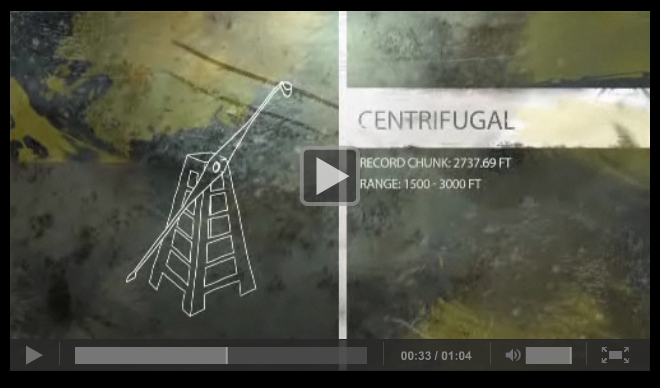
Centrifugals: Consist of a car or truck engine, gearbox, series of propshafts and axles, and armature
Instead of spinning wheels on the ground, the centrifugal machines use the same machination to spin a windmill-esque setup hoisted 30′ above the ground. A pumpkin is cradled carefully at one end of the armature, which is accelerated through the gears to maximum speed. Some teams add to that top speed by then pumping other accelerants into the engine just before hitting the trigger, which releases the pumpkin at a preset point in the spin. This point of release is ingeniously controlled by a repurposed auto distributor setup. At the speed when the pumpkin is released, it’s hard to not be afraid for your safety and everyone else’s in the immediate vicinity. They spin like a helicopter on its side. Inertia II is a new centrifugal machine at Punkin Chunkin in 2009.
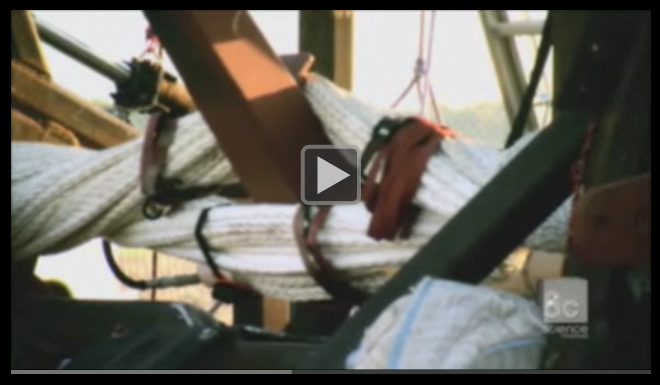
Onagers (torsion catapults): Consist of a rope bundle, throwing arm, and sling
The twisted rope bundle is maybe the perfect form of energy to power a catapult. As the rope is twisted, it stores a rotational energy in what becomes a torsion spring. This rotational energy transfers directly to the throwing arm that is tucked inside it. The arm is cocked into the loaded position, the sling is put in place, and the ammo is loaded inside. A quick release is triggered, the rope bundle snaps the arm forward and the sling whips overhead, launching its cargo with incredible speed.

Hi, I'm Mike. I’m the executive editor of Make: magazine, and host of Discovery channel’s Punkin' Chunkin' and Catch It Keep It, TV shows where I build and explain crazy machines that crush stuff, blow things up, shoot fire, all in the name of science.
I've previously worked at Wired and ReadyMade magazines, writing about how to utilize new technology in our everyday lives.
This site is where I keep a list of instructions for fun projects I've done, am working on, or draw inspiration from. I encourage everyone to get involved — get up and do something!