How Vinyl Records Are Made-And How to Pirate (Copy) A Vinyl Record
Written by mike on July 28th, 2010Vinyl records have a unique place in the world of music media. Aside from their warm analog tone, vinyl is the only popular medium that is nearly impossible to create or duplicate at home – something that can’t be claimed by cassettes, CDs, DVDs, and certainly not mp3s. Not to be an apologist for piracy, this inherently creates more value for recorded music than using an easily reproducible medium (be it physically or digitally) does. But as we all know, digital is the present and the future, and I am not complaining about that at all; one look at my iTunes playlist and you’ll know what I mean.
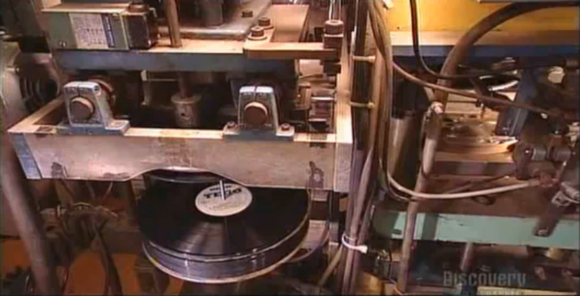
Now, if you haven’t seen the exact process in how records are created, you might be surprised at how much manual cooperation is involved. From inspecting the metal pressing discs and the lacquered masters, to centering the disc for hole punching, you’ve got sweet old ladies who are meticulously making sure your music will sound great. And the actual assembly process, even with automation, is like something you’d see in a Detroit auto maker’s factory: heavy hydraulic equipment pressing hot platters into precision shapes, rotating slicers, and vacuum-assisted label placers.
You can watch the whole process happen, courtesy of Discovery’s “How It’s Made” – part two is where things get interesting.
(also, if you like these DIY projects make sure to add me on twitter and subscribe to my RSS – thanks!)
A while back, the site qj.net ran a piece on how to “pirate” a vinyl record using normal silicone casting materials. Sadly, the link is broken, but thanks to the Wayback Machine, I’ve pulled the archived copy up and am attaching it here for posterity:
Posted May 14, 2006 at 06:49AM by Anna S.Listed in: Misc. Gadgets
So you thought you’ve pirated everything huh?
Step 1
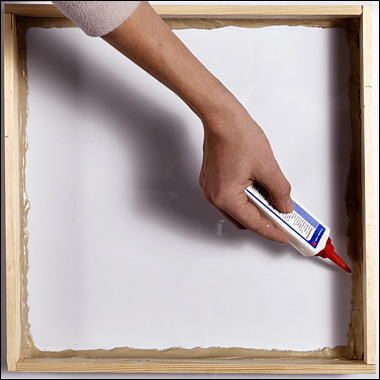
Using the wooden strips, make a box around the glass plate. Seal off the edges using the window cement. Make sure everything is air tight.
Step 2
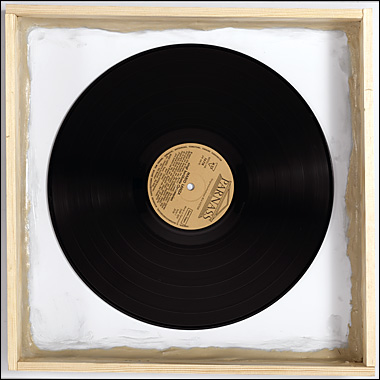
Place your record inside the box making sure that the portion to be copied is facing upward. Squeeze in some window cement to mark where the hole in the record is.
Step 3
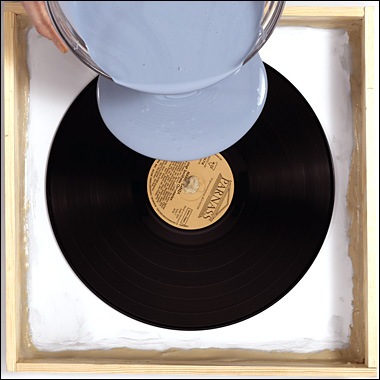
Mix the silicone (Smooth On OOMOO 30 or OOMOO 25) for about 3 minutes before pouring in to the mold.
Step 4
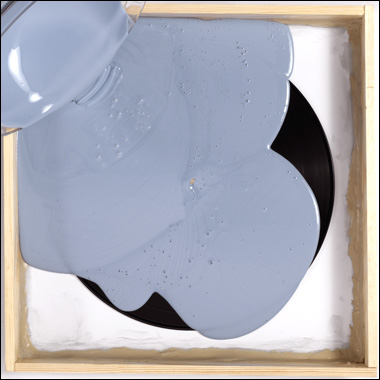
Pour in the mixture. Start from one corner and let it fill-up the mold to about half a centimeter. Make sure it’s even. Let it dry for 6 hours.
Step 5
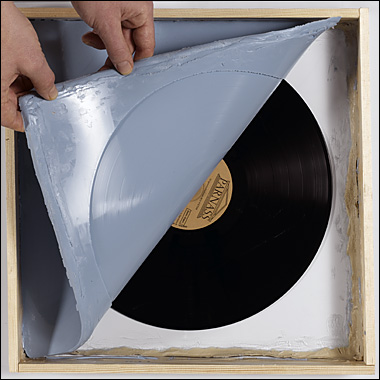
Peel off the silicone from the cast. Cut off the excess using a cutter.
Step 6
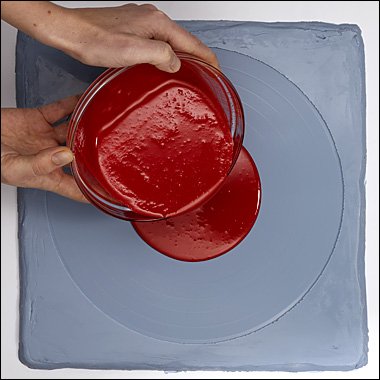
Pour the liquid plastic (Smooth On Task #4) on top of the silicone cast.
Step 7

Make sure that nothing spills over the round form. You can also brush off any air bubbles that might occur.
Step 8

Carefully loosen the plate from the silicone form. Using a drill press, bore a hole through the center of the plate. You can use the silicone form as a template to make more copies.
There you have it. Your very own pirated record.
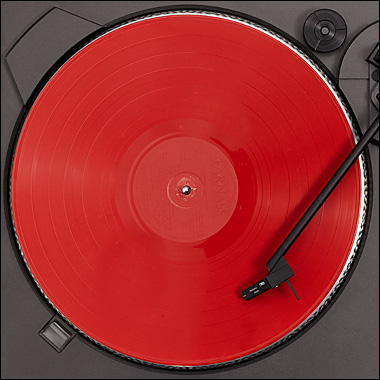
(QJ translated this from the German site Zeit.de, also unavailable except via archive)
How well does this work? To be seen… the next step is to rip a vinyl record (pretty easy to do using a USB turntable), then cast a copy of it using this technique. Rip the copy, compare waveforms and look for any major discrepancies. That’s today’s project.
These links come from the music blog/record label I collaborate on: Sneakmove.com – we have put out a few vinyl records of our own. If you’re into limited edition 7″ compilations featuring unique songs from amazing bands, you should take a peek at our catalog and help support independent music by purchasing a collectible record or two.
I’ll give a “DO IT Reader’s Discount” to anyone buying Minicomp 2, Minicomp 3, or the Languis/MMC split CD: $4 each. Click the album cover below to order with the special price.
Related posts:
- DIY Lamp From Translucent Vinyl 45s – Instructable
- Found another great instructable at instructables.com. Perfect project for the music fan. Lamp made from...
- How to Make A Digital Pinhole Camera – Fast, Cheap and Easy
- The most basic style of camera is the pinhole camera, usually a light-proof box that...
- Make a Perforated Pizza Peel for Improved Pizza Making
- After getting to use Pizzahacker’s perforated pizza peel, I decided to make a DIY...
- If You Can Cut and Fold Paper, You Can Make These Papercraft Pizza Toys
- Another fun project to sneak in at the end of a slow day in the...


28
PM
That’s amazing. I guess I never realized how easy it is to work with silicone – with or without the records.
29
AM
There isn’t a complete list of materials-you write “Using the wooden strips, make a box around the glass plate.” Some better directions would’ve been more helpful. Also, does this render the original vinyl useless? How do we clean the original after we try this?
29
AM
Sarah, you’re right – I’ve taken the writeup as posted on the original site (QJ.net) and posted it here as it was written. Materials and specific directions are sparse in their post.
I too am curious as to how this would affect the original vinyl and will be testing it myself this week. Will let you know as I find out more.
29
AM
I guess a complete list of materials to make wooden strips would be wood?
29
AM
Great info! – Would be interested to see how it compares to original in terms of quality?
29
AM
YES! I wish I had thought of this when I had some leftover silicone and plastic recently….
29
AM
@Sarah + Pedro:
Really? You guys couldn’t figure out wood and fasteners? If so, this project is above your skill level.
Or were you just being needlessly pedantic?
Mike: Cool article, and nice website necromancy. Your profile pic is a bit angry/scary looking though, FYI
29
PM
So even the post about pirating is pirated.
“Written by Mike” seems a bit misleading in that case, doesn’t it?
29
PM
I’ve done a fair amount of home casting with various RTVs and have seen them lift the texture detail off the masking tape used to build surround boxes. However I’m curious to see if the RTV is good enough to pick up all the details of the record grooves for decent playback.
Not to mention that fact that a single airbubble trapped on the surface is going to sound terrible. I notice you poured on the RTV, did you consider brushing it on as well?
29
PM
What gast! says!
29
PM
@jungletek
I think their issue is that the article implies that there was a list of materials included. The post should be edited in some way to fix that.
Also between step 7 and 8 it doesn’t tell you how long to expect to leave the vinyl in the form. It goes from brush off the air bubbles to remove the plate.
It’s just weird to read stuff that sounds incomplete.
29
PM
It looks like you can pick up Oomoo silicone and liquid plastic at smooth-on.com. Trial sizes (3lbs & 2lbs, respectively) are about $25 each. Seems a little pricey with the phrase “trial size” involved, but still kinda cool.
29
PM
I wonder too whether dirt on the record surface might affect the overall sound of the copy?
…and might this be an effective way to clean a record without using an expensive dust extracting machine? ie. one cast to get out the dust, a second to copy the (now) clean vinyl?
29
PM
Search the web for record cleaning using wood glue. This one made the rounds several months ago.
30
AM
The first Step was more verbose in german. It goes: Nail together four 36.5cm-pieces of wood to create a frame and put it on a glass plate. Also i dont know if “window cement” is the right thing, my dictionary translates “Fensterkitt” with putty.
Also i’d guess the squeezing-in part for the record hole is not helping – if you just leave the original hole, the silicone negative will then have a cylinder that does not get filled with the resin, so you’d get a deeper hole that way.
30
AM
out of curiosity, have you done subjective listening comparisons between the originals and copies? any crazy differences?
there’s a lot of crazy sheet that can go on with casting plastics (3% shrinkage during curing = shift towards “alvin+chipmunks” sound)
also, if the silicone doesnt’t fill the grooves etirely – especially the tiniest grooves (due to surface tension during silicone and liquid plastic steps), i’d expect a cut in high freq’s vs. the original recording. records don’t have the best high freq response in the first place, so I could imagine this being really detrimental to the original sound.
in any case, in summary, has anyone tried this – and can you tell ANY difference?
30
AM
It would be wise to use a centering dowel (equal to the diameter of the center hole) in the box to place the record on. This will eliminate the difficult process of finding and drilling out true center for your copy because the hole will already be present.
30
AM
Shrinkage wouldn’t affect pitch, because that is determined by the rotation speed of the turntable. Shrinking the record will only effect the amplitude (sound level).
I would be also interested to see if anyone has really done this, with sound samples of the finished copy vs. original.
30
AM
fiz todos procedimentos passo a passo e o disco (legiao urbana ) ficou aparentemente perfeito mas as musicas estao com alguns ruidos em algumas faixas.
adorei !
30
AM
That’s great for casting one side of the LP…aren’t most records TWO-SIDED?!?
30
AM
For sake of curiosity and experimental ’soundness’ could you also compare the original to itself on two separate runs? A low end & low quality turn table can sometimes be quite inconsistent in performance and while I have no idea how that one performs, it would be nice to see how consistent that turntable actually is.
31
AM
Headline should be modified: copying is not “to pirate”.
31
PM
At my work, when we cast parts in epoxy, we put them in a vacuum chamber for a few minutes to draw out the air bubbles. So, seal up the wooden frame, place a sealed lid on top and pull a slight vacuum for a while. Should prevent air bubbles being trapped at both casting steps.
1
PM
I think if I were to go to all this trouble, I’d try to get two copies of the LP in question. After pouring the silicone for the one side, I’d press my second copy on TOP of the mold in order to copy the other side…thus making a double-sided copy in one pass.
How to get both sides onto vinyl is someone else’s problem.
1
PM
just give a look at the “smooth on” website for details:
http://www.smooth-on.com/gallery.php?galleryid=157&cPath=1157
1
PM
too bad this was never perfected:
http://www.phys.huji.ac.il/~springer/DigitalNeedle/
1
PM
re: http://www.phys.huji.ac.il/~springer/DigitalNeedle/
I did come across the actual software a few years ago…it works to an extent, but not enough to actually use.
2
AM
“Shrinkage wouldn’t affect pitch, because that is determined by the rotation speed of the turntable. Shrinking the record will only effect the amplitude (sound level).”
It may affect pitch as well as amplitude, because the original tracks are cut at a predetermined speed. When you shrink the record, you are not just shrinking the amplitude, you’re decreasing the period of the waveform in the grooves as well. Imagine two lines of the same length starting from the same origin and 5% apart in angle. Now cut the distance in half. A line drawn between the end points would be shorted. Pythagorean theorem applies
So you’re both correct.
If the shrinkage is 3%, just run at -3% pitch? (Something tells me the math is more complicated and you’d need to run it lower than that). I’m posting from a commuter train so I don’t feel like figuring this all out right now, it’s nap time.
2
AM
@am
you’re right about the length of line, but shrinkage will still not affect pitch: Even if the record shrinks 50% in size, the number of record turns required to play it will stay the same – The needle just doesn’t have to cover as much disctance as far as before. And when the number of turns stays the same, the playtime stays the same and so does the pitch of the recording.
2
AM
Sarcasm is the lowest form of wit…
2
AM
So I met a guy who’s done this. Don’t know if this has been mentioned (didn’t read all the comments) but he used old wooden picture frames with glass sealed up with silicon for the box. Had a few different ones, that’s why I asked about them. He just said what he used them for, not how it works. Now I know. thanks
2
PM
Why plug up the hole in the original? You’re essentially creating a negative with the silicone. If you just taped it from the other side, silicone would fall into the hole, leaving a bump in the silicone negative (a negative hole).
Then, when you pour on the plastic, the hole would be re-created in the positive. No need for a drill press.
3
AM
I’d like to hear a “before and after” comparison before I pass any judgment.
Presenting this approach as a *back-up* for a recorded medium, without understanding what that back-up was going to sound like is a bit premature – don’t you think?
3
AM
Wow!!!
This looks very interesting!
Please, could someone post some experiments about this?
-Sound Quality on original/copy
-Any ways to make a 2 sided vinyl
-manner to avoid bubbles in the silicon
I hope we can improve this technique to make a decent final product.
By the way, is the final silicon as ’solid’ as an original vinyl or is it some kind of a flexidisc?
How much should we count for a replica of an LP?
Thanks, thanks thanks!!!
3
AM
About shrinkage, I’ve found this info on the OOMOO25/30:
Shrinkage: .0025 in./in.
Is this ‘negligeable’?
3
PM
very very interesting. Could be an useful way to keep the originals pristine – play only the copies till they’re worn out and make another copy? – if, as everyone’s asking, the quality on the copy is good enough. I had another thought – what’s the “harshness” of the set liquid plastic like – any more or less likely to cause needle damage?
3
PM
Six hours just to make the silicone mold? And I used to think hi-speed dubbing with cassettes took forever!
I actually remember when this article was originally posted 4 or 5 years ago. It was taken down with the quickness…glad you were still able to find it as it wasn’t up for very long at all.
4
AM
I’ve done tons of work with silicone molds. Few things:
- Silicone would not damage record. It would just peel away. The label however is a different story.
- Wood, paper, etc… are porous materials. Silicone can soak in and urethane will definitely soak into them. Acrylic works much better for boxes. Silicone peels right off.
- Putting a dowel in the center is a good idea. Just leave the dowel in when you cast your part and there’s your center hole. Metal is preferable as anything else would tend to bind to the material of our cast record.
- Shrink would be negligible. The above example of .0025 in/in would men that a 12″ record might shrink .012″ across the diameter. A sheet of paper is about .004″.
The problem I see with this method, is that is the side of the silicone that is in open air (opposite the record) doesn’t cure perfectly flat, when you flip it over to pour in your urethane (or whatever mat’l for the record) it’ll be warped and you’ll get a warped record.
4
AM
Ugh. Regarding the shrink: Bad math on my part. A 12″ record could shrink .030″ across the diameter at a shrink rate of .0025 in/in. Still would be pretty negligible in my opinion.
Also, platinum based rubber (as appose to silicone) would probably hold more definition and is a “stiffer” more solid rubber. Of course it’s more expensive though.
4
AM
how many copies could you make from this? I’m assuming that it would be unlimited, in which case, you could get your records pressed at a pressing plant and when you get the test presses, you just do this with them and you can press your own. Kind of a sketchy thing to do, but it’s a lot cheaper than paying for them all to get pressed.
4
AM
Thanks for sharing your experience with us, James!
I’m still looking for someone who could have done this vinyl replication…
More, how we could make it on both side as a ‘normal’ vinyl?
I’d like to ‘clone’ some of my gems here, most of them are records that don’t exist anymore…And they are not on CD as well…
4
AM
@Nishad
Getting the test pressings done (with all transfers from the plates) is the most expensive part of the process.
To get the records pressed is very low cost regarding all the preparation/transfers for the master plates.
4
AM
I’m going to guess at 40 records before the rubber started to break down. Sooner or later it just gets worn down and little chucks will break away and stick to the poured part. The rubber that make the grooves will be very thin and delicate. Using a release agent (think Pam only for rubber/urethane) helps.
Making a double sided record… well the mold is doable no problem. Filling (without voids/air bubbles) would probably be very difficult.
4
AM
;-(
So… I have to stick with the one-sided plate…
OK, why not.
4
PM
Excellent stuff =) I’m gonna try this out on some of my “worthless” records to make sure they don’t get damaged in the process. If it works alright, I can copy some of my rare vinyls and play the copies while preserving the originals =)
5
AM
check http://www.dubplate.be to get your tracks cut on vinyl
5
AM
dubplate.be > very expensive, and we can’t put more than 9 min on a 12″side? Not interesting at all…
5
PM
Some of these resins are no longer available, but the same process using current Smooth-On products is described here
5
PM
The thing is they use a vaccum to avoid bubbles in the mold without showing what they do exactly. Well… to someone in this activity, it could be easy to figure what’s goin on… But to me (newbie) I would appreciate finding a more complete tutorial, with details on the products to use and how exactly to use them.
5
PM
Jeremy, James et al,
Loving these comments. I’m hoping to get a test up and posted by early next week. Lots of learning for me on this too!
5
PM
Have fun doing it Mike!
I’m looking forward to reading your report.
Best,
8
AM
Cool moulding, esp. using an old picture frame , and dowel, I would Varathane the dowel so nothing would tend to stick , or Future acylic , perhaps, worth a try , also if the sound is decent. I have Lp’s out of print so I may try this, for my own use, thanks !
20
AM
@Jeremy. The reason that you cannot cut more than (usually) 9 minutes on as 12″ is because the bass grooves especially begin to overlap/cut into each other causing the stylus to jump. This is besides the fact that this process professes to copy vinyl NOT cut it. I don’t understand from your post but you cannot avoid a professional test pressing and I wouldn’t like to try this with a dubplate!
21
PM
waiting on the results of the experiment Mike, early next week was last week btw, hahah!
… really want to try this when I return home.
22
PM
What,s hapend with the b Side?
Can i only make a A Side Record?
23
PM
@liam. I know places able to cut more than 9 minutes on a side of a 12″. 50 euros (without taxes and shipping charges) for a 12″ with only 9 minutes per side is not cheap.
28
AM
make two thin plastic copies then glue them back to back some how to make a complete copy might work it will look grungy but Im thinking with some trials and attempts it could work
29
PM
Why the bother? Just digitize it!